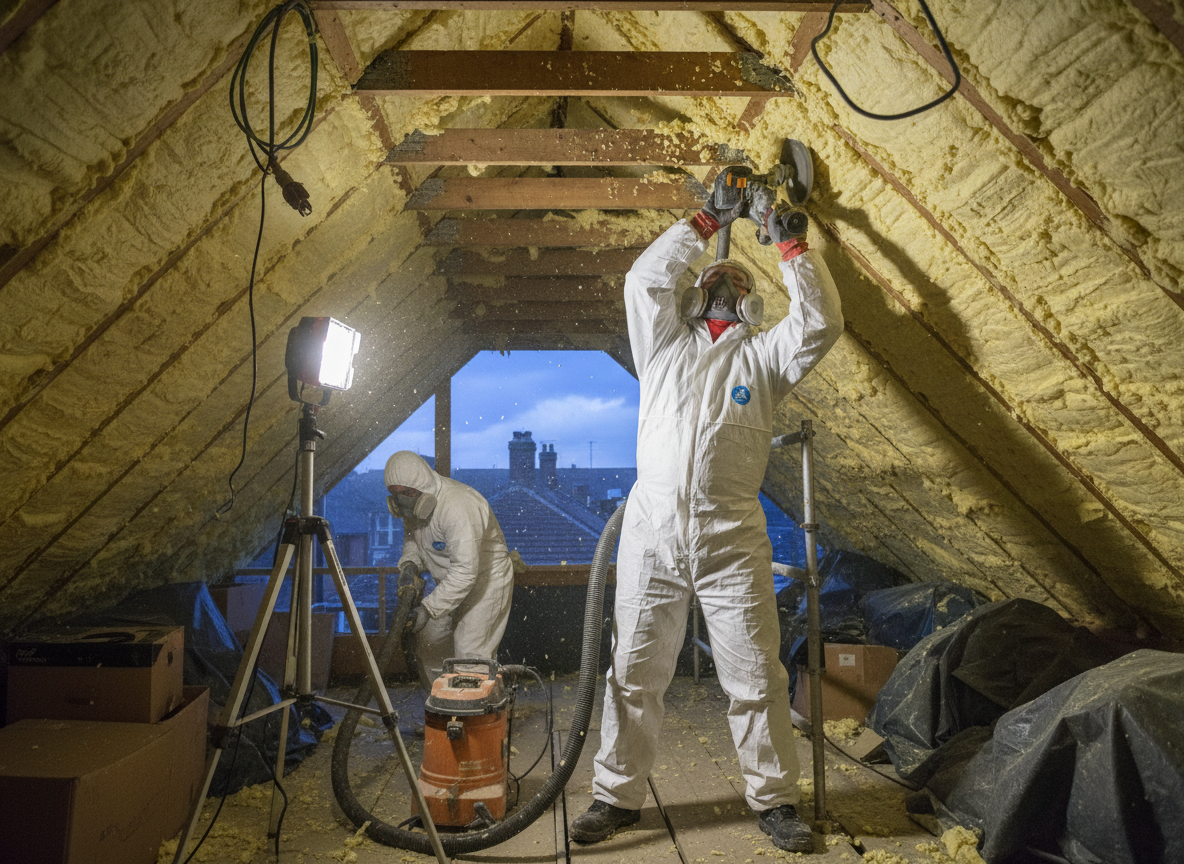
Hull's older housing stock, particularly Victorian terraces and early 20th-century semis common in areas like the Avenues and Newland, often received spray foam insulation in lofts during past energy schemes. Over time this closed-cell foam traps moisture against original timber joists and lath ceilings, especially when combined with the region's frequent rainfall and poor loft ventilation. Removal requires careful mechanical scraping and vacuum extraction to avoid damaging historic plasterwork or releasing fibres into living spaces below.
Work in Hull frequently involves properties near the River Hull and Holderness Drain where seasonal flooding raises ground moisture levels. Foam applied directly to roof decks in these homes can conceal rot that only becomes visible once the material is stripped. Technicians must inspect for water ingress points around chimneys and valleys before starting, then dispose of the removed foam as construction waste through licensed local routes rather than general landfill.
Night and weekend call-outs are common because many Hull residents only notice insulation failure when heating bills spike in winter or when estate agents flag the material during sales. The 24/7 service from the base at 94 Alfred Gelder Street allows crews to reach properties in Sculcoates or Drypool before daytime traffic builds on the A63. Safe access through loft hatches in narrow terrace layouts often requires temporary flooring and dust containment sheeting to protect bedrooms directly underneath.
Local building control in Hull now expects proof that removed foam has not compromised fire separation between attached properties. Crews document the condition of party walls and ensure any exposed timber is left clean and dry before handover, preventing future claims when homes change hands.
Technician insight
In Hull, the thing that catches most people out with 24/7 Spray Foam Removal is how often foam was sprayed straight onto the underside of slate roofs in 1960s terraces near the docks, trapping condensation that rots the battens once winter gales drive rain under the tiles.
Night Removal in Sculcoates Terrace
Homeowner in a Sculcoates back-to-back terrace noticed damp patches on bedroom ceilings after heavy rain. Inspection found closed-cell foam bridging a slipped slate and trapping water against the joists. Crews arrived at 2 a.m., contained the loft, stripped the foam in sections and left the timber exposed to dry before the morning commute started on Beverley Road.
How it works
- 1
Initial Assessment
Visit the property in Hull to inspect foam condition, access points and any signs of moisture damage in lofts or wall cavities.
- 2
Containment Setup
Install dust barriers and floor protection to keep debris out of living areas common in tight terrace layouts.
- 3
Foam Extraction
Use mechanical tools and HEPA vacuums to remove the spray foam without damaging original roof structures or ceilings.
- 4
Site Clearance and Disposal
Bag and remove all waste through approved Hull routes, then clean the space ready for re-insulation or inspection.
Pricing
Cost depends on property age, foam thickness and access difficulty in Hull terraces; upfront quotes provided after inspection.