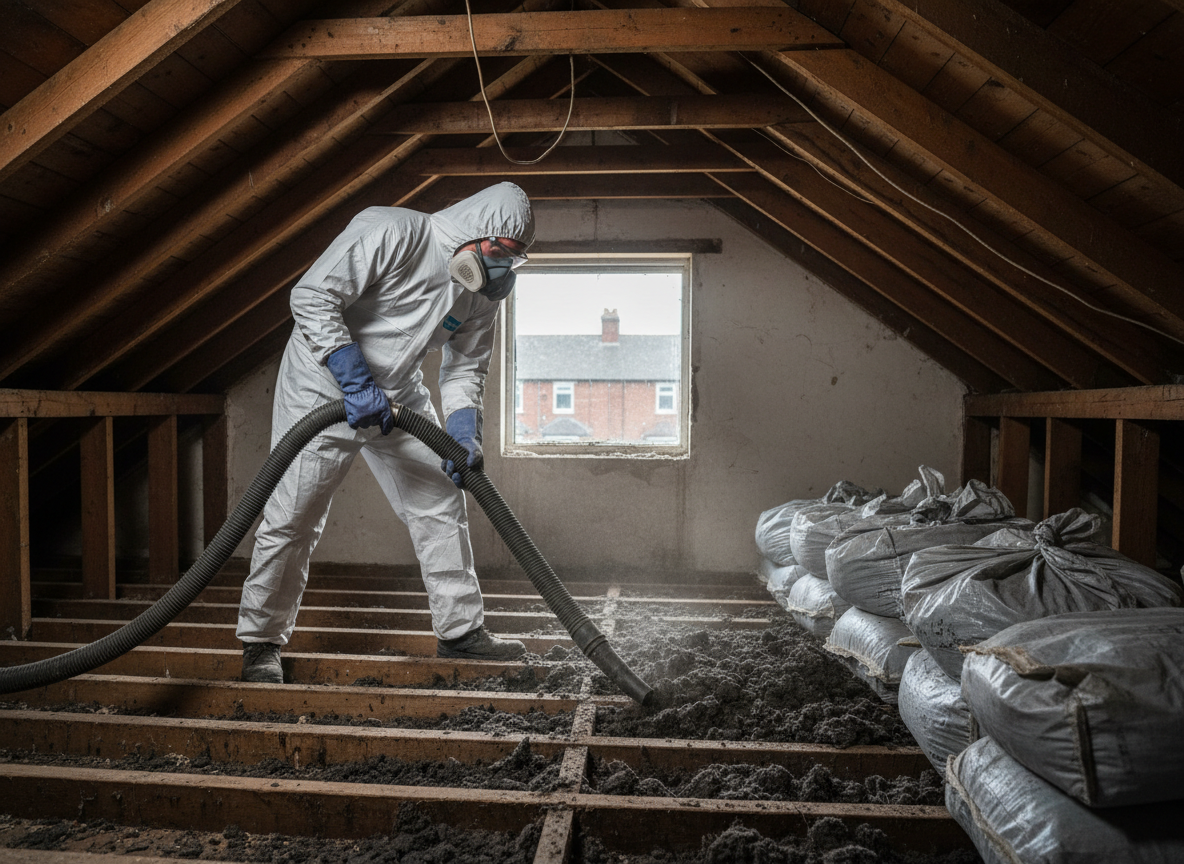
Hull's Victorian and Edwardian terraces, especially those lining streets near the Humber estuary, frequently received closed-cell spray foam in the 2000s to meet energy targets. Over time the foam bonds to rafters and prevents the roof from breathing, so condensation builds on the underside of tiles and soaks into original timber. Removal requires cutting the foam into manageable sections without damaging lathe and plaster ceilings below, then bagging it for licensed disposal at the local waste facility.
Wind-driven rain off the North Sea and high groundwater around the city centre mean many properties already sit close to the damp threshold. Once foam is gone, we check for hidden rot in joist ends and advise on adding ridge and eaves ventilation that meets current Yorkshire building control expectations. Homeowners often discover the job also restores the ability to inspect wiring and pipework that had been buried.
Edge cases include listed buildings around the Old Town where listed-building consent is needed before any roof work, and mid-terrace houses on Hessle Road where shared chimney stacks complicate extraction. We always start with a torch-and-camera survey to map foam depth and any asbestos-containing materials in older insulation layers.
Technician insight
In Hull, the thing that catches most people out with insulation removal service is how quickly the Humber estuary damp gets into rafter ends once the foam is stripped; terraces built before 1919 often have no felt under the tiles, so you have to open the eaves the same day or you risk new rot within weeks.
Foam Removal in a 1905 Terrace off Beverley Road
Homeowner noticed black mould on bedroom ceilings after years of closed-cell foam. Survey found saturated timber where the foam met the brickwork. We extracted the foam over two days, added new ridge vents and left the loft clear for the owner to add mineral wool later.
How it works
- 1
Site Survey
We attend the property in Hull to measure foam coverage, check for moisture damage and confirm access routes through the loft hatch or external scaffolding.
- 2
Containment Setup
Plastic sheeting and negative-air units protect living spaces below while we work, especially important in the compact layouts of Hull terraces.
- 3
Foam Extraction
Technicians cut and peel the spray foam in sections, taking care around electrical cables and pipework common in pre-1919 stock.
- 4
Clearance and Ventilation Check
All debris is removed, the loft is swept, and we test airflow at ridge and eaves before handing back the space.
Pricing
Cost depends on loft size, foam thickness and access difficulty; we provide an upfront quote after the survey and work to fixed pricing once agreed.