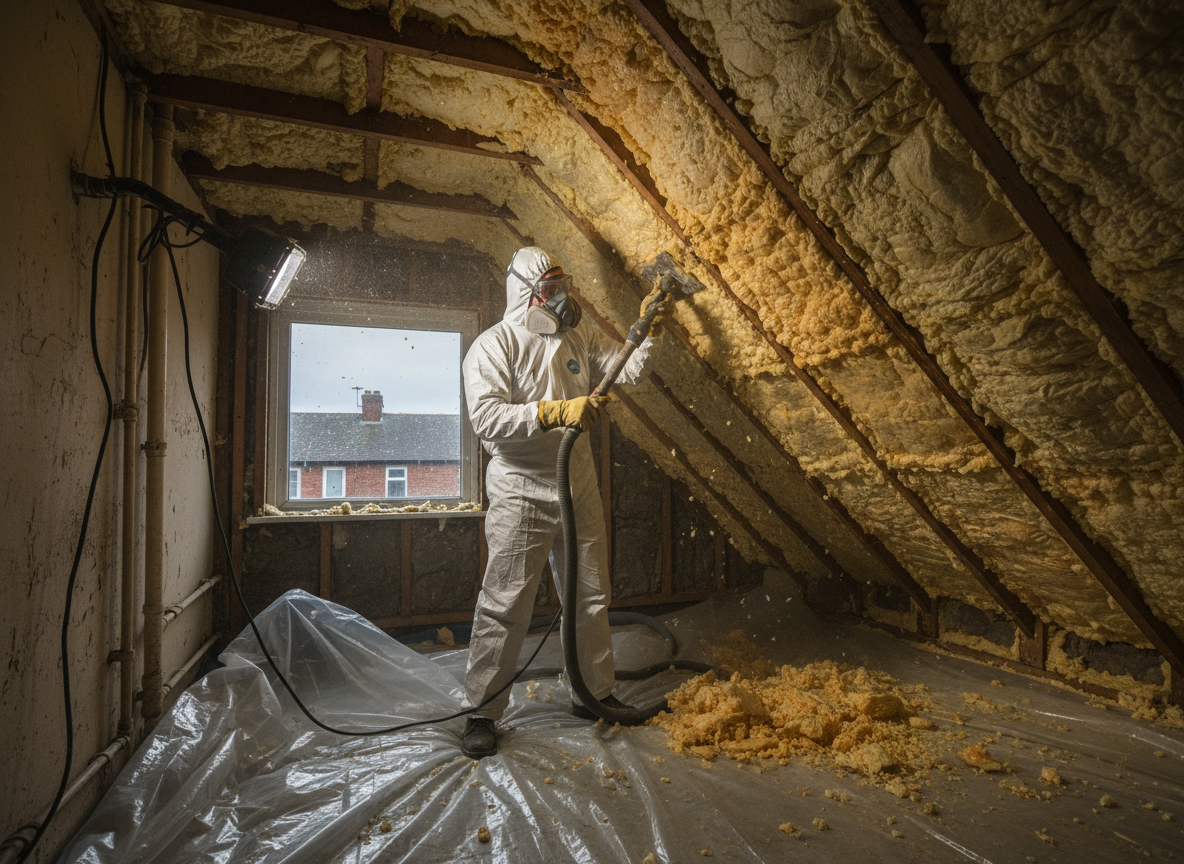
Hull's Victorian and Edwardian terraces often received spray foam in lofts and cavities during the 2000s energy upgrades. Over time the closed-cell material trapped condensation against brickwork and timber, especially in properties close to the Humber where salt air and frequent rainfall increase internal humidity. Removal requires cutting the foam in sections while protecting original lath and plaster ceilings that are common in these homes.
Access in narrow ginnels and shared roof spaces between terraces adds complexity. Technicians must contain dust and debris to avoid affecting neighbouring properties, then restore airflow through eaves and ridge vents that were frequently blocked during the original installation. Failure to reopen these paths leaves residual moisture that can lead to rot in rafters within a single winter season.
Post-removal inspection includes checking for hidden damp in party walls and ensuring any insulation remaining in external walls is compatible with the solid brick construction typical of Hull's pre-1919 stock. Waste is bagged on site and removed the same day to prevent recontamination of the loft space.
Technician insight
In Hull, the thing that catches most people out with spray foam insulation removal is how quickly moisture builds behind foam in the solid-wall terraces near the docks once the original roof vents were sealed; homeowners often only notice when black mould appears on bedroom ceilings after a wet winter.
Loft Removal in a Hull Terrace
A homeowner in a 1900s terrace off Holderness Road reported musty smells and peeling wallpaper. Inspection showed closed-cell foam had blocked all eaves ventilation and trapped rainwater ingress. We removed the foam in sections, reopened the vents and cleared debris the same day, allowing the rafters to dry naturally before winter.
How it works
- 1
Initial Survey
Assess foam depth, substrate condition and ventilation paths in the specific Hull property.
- 2
Containment Setup
Seal work areas with sheeting to protect floors and neighbouring homes from dust.
- 3
Foam Extraction
Cut and remove foam in controlled sections while monitoring for hidden moisture or timber damage.
- 4
Ventilation Restoration
Clear eaves, install or reopen vents and confirm airflow before final cleanup.
- 5
Site Clearance
Remove all debris and waste, then conduct a final moisture check.
Pricing
Cost varies with foam thickness, access difficulty in terraced lofts and extent of any damp remediation required; inspection provides the accurate figure.